When the universe’s largest stars run out of fuel and die, they explode in technicolor tsunamis of gas and dust that can stretch on into space for dozens of light-years. To see the full array of cosmic colors left behind by a star gone supernova, you generally need some pretty sophisticated telescopes capable of seeing light beyond the visible spectrum. But today, you can grab a front-row seat to those cosmic pyrotechnics by clicking over to this new 3D simulation released by the Smithsonian.
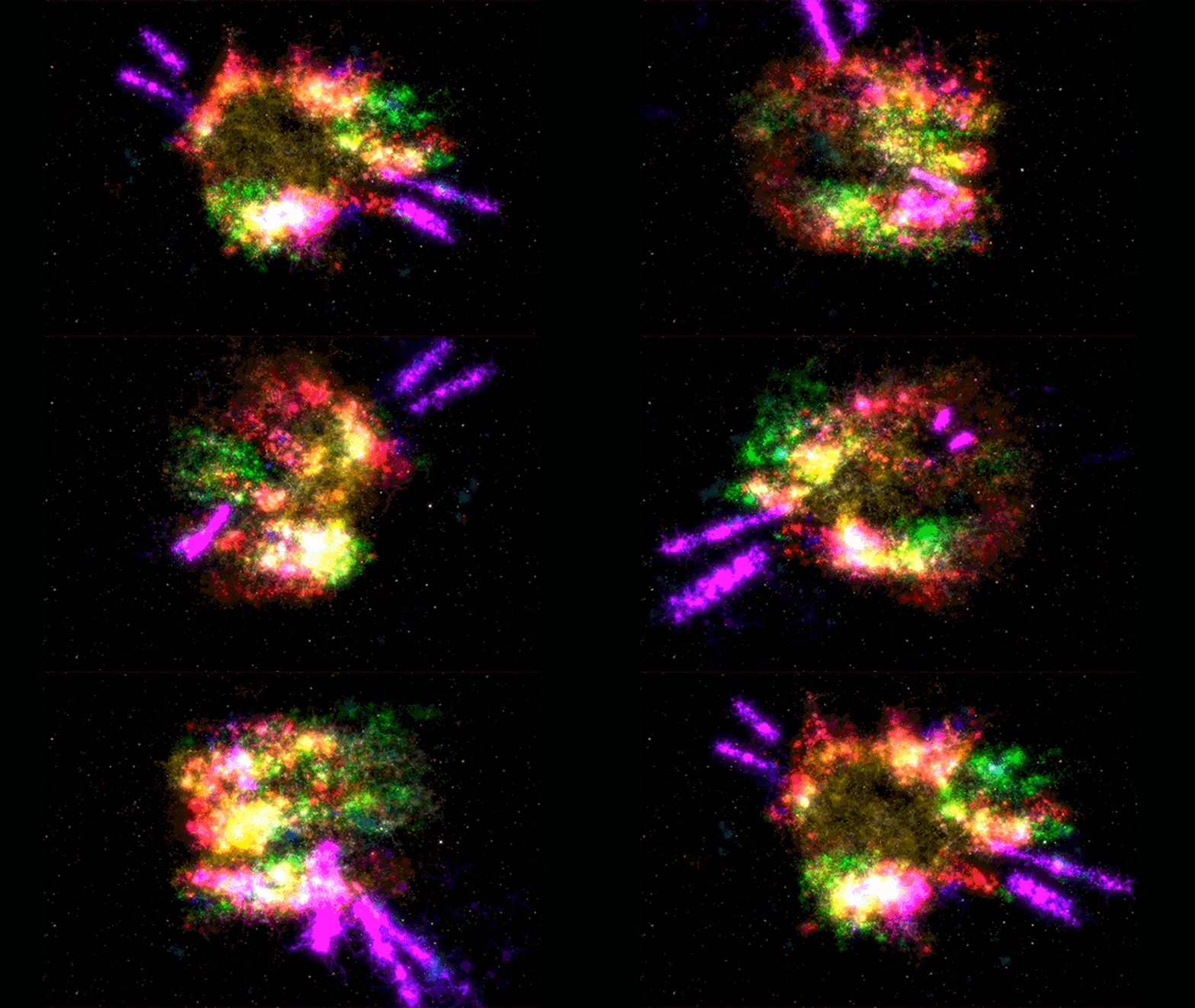
The interactive, 360-degree graphic allows armchair astronauts to navigate through the heart of a supernova remnant using just their mouse and arrow keys. The simulation shows the likeness of an actual supernova site called Cassiopeia A, a 10-light-year-wide cloud of stellar debris located in the Milky Way’s Cassiopeia constellation (about 11,000 light-years from Earth). The supernova’s colorful likeness was re-created using actual observations measured in gamma ray, infrared, ultraviolet, X-ray and radio wavelengths, provided by half a dozen observatories around the United States. [15 Amazing Images of Stars]
With all these elusive light sources laid on top of one another, the resulting image is a rainbow collage of green iron, yellow silicon, red argon and magenta neon gas clouds crisscrossed by purple jets of scorching-hot matter streaking out of the debris. At the center of this gassy mosaic is the ominous image of a neutron star — the ultradense, ultrasmall core of the collapsed giant star responsible for the supernova debris in the first place.Advertisement
Cassiopeia A was first described in 1947, but researchers think its light first appeared in Earth’s sky about 300 years ago. The colorful shell of gassy debris is still thought to be expanding — possibly as quickly as 3,700 miles per second (6,000 kilometers per second), according to a 2006 study — and might have a temperature of about 50 million degrees Fahrenheit (28 million degree Celsius). For now, it’s probably best just to visit on your computer screen.
Replace the question marks in each of the following:
Q1. 927, 215, ? ,612, 521
Q2. 61, 52, 63, ?, 46, 18
Q3. 1, 3, 4, 8, 15, 27, ?
Q4. 1, 28, 92, 217, 433, 776, ?
Q5. 1, 1, 2, 6, 24, ?, 720
Q6. 7, 9, 66, 12, 14, 66, 17, ?, ?
Q7. 3, 2, 8, ?, 13, 22, 18, 32, 23, 42, ?
Q8. 2, 1, 2, 4, 4, 5, 6, 7, 8, 8, 10, 11, ?
Q9. 1, 0, 3, 2, 5, 6, ?, 12, 9, 20
Q10. 2, 2, 4, 6, ?, 10, 8, 14, 10, 18, 12
Q11. 20, 36, 61, 97, 146, ?
Q12. 57, 79, 911, 1113, 1315, ?
In today’s world children of 1-5 years have become mobile worms and game worms. Now enhance the knowledge of your childrens by finding these type of interesting questions and take them into the world of sucess.
If you like these please publicize these through whatsapp and instagram. And make the next generation aware of there knowledge.
How much do you know about the city you live in? Sure, you’ve got your favorite restaurants and the best way to avoid traffic during rush hour, but it’s unlikely you know the details of every urban nook and cranny. The same goes for the galaxy you live in, the Milky Way.
Our celestial home is an awe-inspiring place full of stars, supernovas, nebulas, energy and dark matter, but many aspects of it remain mysterious, even to scientists. For those seeking to better know their own place in the universe, here are 11 enlightening facts about the Milky Way.
2 of 12Credit: Universal History Archive/UIG via GettyThe MIlky Way’s name is ancientBefore the advent of electric lights, everybody on Earth had an unobstructed view of the night sky. The enormous milky band of stars crossing it was impossible to miss. Ancient peoples gave different names to the cloud-like structure of our galaxy, but our modern version derives from the Greeks, who had a myth about the infant Hercules being brought to the goddess Hera, who nursed him while she was asleep. When she awoke and pulled away, her breast milk spilled across the heavens. The source of the Greek name itself has been lost to the ages, Matthew Stanley, a professor of the history of science at the Gallatin School of Individualized Study at New York University, previously told Live Science. “It’s one of those terms that’s so old that its origin is generally forgotten by now.”
3 of 12Credit: Two Micron All-Sky SurveyWe’re not sure exactly how many stars are in the Milky WayCounting stars is a tedious business. Even astronomers argue over the best way to do it. Their telescopes see only the brightest stars in our galaxy, and many are hidden by obscuring gas and dust. One technique to estimate the stellar population of the Milky Way is to look at how fast stars are orbiting within it, which gives an indication of the gravitational tug, and therefore the mass, of the galaxy. Divide the galactic mass by the average size of a star and you should have your answer. But as David Kornreich, an astronomer at Ithaca College in New York, told Live Science’s sister site Space.com, these numbers are all approximations. Stars vary widely in size, and many assumptions go into estimating the number of stars residing in the Milky Way. The European Space Agency’s Gaia satellite has mapped the location of 1 billion stars in our galaxy, and its scientists believe this represents 1 percent of the total, so perhaps the Milky Way contains about 100 billion stars. [Large Numbers That Define the Universe]
4 of 12Credit: ShutterstockNobody knows how much the Milky Way weighsOn a related note, astronomers are still unsure exactly how much our galaxy weighs, with estimates ranging from 700 billion to 2 trillion times the mass of our sun. Getting a better grasp is no easy task. Most of the Milky Way’s mass — perhaps 85 percent — is in the form of dark matter, which gives off no light and so is impossible to directly observe, according to astronomer Ekta Patel of the University of Arizona in Tucson. Her recent study looked at how strongly our galaxy’s humongous mass gravitationally tugs on smaller galaxies orbiting it and updated the estimate of the Milky Way’s mass to 960 billion times the mass of the sun, Live Science previously reported.
5 of 12Credit: Springel et al./Virgo ConsortiumThe Milky Way is probably in a big, empty spot in the universeSeveral studies have indicated that the Milky Way and its neighbors are living out in the boonies of the cosmos. From afar, the large-scale structure of the universe looks like a colossal cosmic web, with string-like filaments connecting dense regions separated by enormous, mostly empty voids. The emphasis in that last sentence should be on “mostly empty,” since our own galactic abode seems to be an inhabitant of the Keenan, Barger and Cowie (KBC) Void, named after three astronomers who identified it in a 2013 study in The Astrophysical Journal. Last year, a separate team looked at the motion of galaxies in the cosmic web to provide additional confirmation that we’re floating in one of the big, empty areas, Live Science previously reported.
6 of 12Credit: NASA/CXC/Columbia Univ./C. Hailey et al.Astronomers are trying to photograph the monster black hole at the Milky Way’s centerLurking in the heart of our galaxy is a hungry behemoth, a gigantic black hole with the weight of 4 million suns. Scientists know that it’s there because they can trace the paths of stars in the Milky Way’s center and see that they seem to orbit a supermassive object that can’t be seen. But in recent years, astronomers have been combining observations from multiple radio telescopes to try and get a glimpse of the environment surrounding the black hole, which is packed with gas and dust spinning around the black hole’s maw. The project, called the Event Horizon Telescope, expects to have preliminary images of the black hole’s edge in the coming months, according to the team’s blog. [Stephen Hawking’s Most Far-Out Ideas About Black Holes]
7 of 12Credit: Juan Carlos Muñoz/ESOSmall galaxies orbit the Milky Way and sometimes crash into itWhen Portuguese explorer Ferdinand Magellan sailed through the Southern Hemisphere in the 16th century, he and his crew were among the first Europeans to report on circular clusters of stars in the night sky, according to the European Southern Observatory. These clusters are actually small galaxies that orbit our Milky Way like planets around a star, and they have been named the Small and Large Magellanic clouds. Many such dwarf galaxies orbit ours — and sometimes they get eaten by our massive Milky Way. Earlier this year, astronomers used new data from the Gaia satellite that showed millions of stars in our galaxy moving in similar narrow, “needle-like” orbits, suggesting they all originated from an earlier dwarf galaxy dubbed “the Gaia Sausage,” as Live Science reported at the time.
8 of 12Credit: NASA/JPL-CaltechThe Milky Way is full of toxic greaseSwirling through the mostly empty space between stars in our galaxy is a bunch of dirty grease. Oily organic molecules known as aliphatic carbon compounds are produced in certain types of stars and then are leaked out into interstellar space. A recent study found that these grease-like substances could account for between a quarter and one-half of the Milky Way’s interstellar carbon — five times more than previously believed, as Live Science reported in June. Though strange, the findings are cause for optimism, according to researchers. Because carbon is an essential building block of living things, finding it in abundance throughout the galaxy could suggest that other star systems harbor life.
9 of 12Credit: ShutterstockThe Milky Way is going to crash with its neighbor in 4 billion yearsSad to say, but our galaxy isn’t going to be here forever. Astronomers know that we are currently speeding toward our neighbor, the Andromeda galaxy, at around 250,000 mph (400,000 km/h). When the crash comes, in about 4 billion years, most research has suggested that the more massive Andromeda galaxy would swallow up our own and survive. But in a recent study, astronomers reweighed Andromeda and found that it was roughly equivalent to 800 billion suns, or about on par with the Milky Way’s mass, as Live Science previously reported. That means that exactly which galaxy will emerge less scathed from the future galactic crash remains an open question.
10 of 12Credit: ESA/Marchetti et al 2018/NASA/ESA/Hubble/CC BY-SA 3.0 IGOStars from our galactic neighbors are racing toward the Milky WayMovie stars in films are known to swap spit, but who knew that galaxies in the universe sometimes swap stars? Researchers were recently searching for hypervelocity stars, which get thrown at mind-bending speeds from the Milky Way after interacting with the giant black hole in its center. What they found was even stranger — rather than flying away from our galaxy, most of the fast stars they spotted were barreling toward us. “These could be stars from another galaxy, zooming right through the Milky Way,” Tommaso Marchetti, an astronomer at Leiden University in the Netherlands, said in a statement. In the study, which was published Sept. 20 in the journal Monthly Notices of the Royal Astronomical Society, the authors suggest that these odd stars could have originated in the Large Magellanic Cloud or some other galaxy farther away and write in their paper that the discovered objects “may constitute the tip of the iceberg” of a large population of similar stars.
11 of 12Credit: NASA GoddardThere are mysterious bubbles arising out of the Milky WayImagine discovering that your living room, which you’ve seen a million times before, contained a previously unnoticed elephant. That’s more or less what happened to scientists in 2010 when they uncovered gigantic, never-before-seen structuresstretching for 25,000 light-years above and below the galaxy. Named ‘Fermi bubbles’ after the telescope that found them, these gamma-ray-emitting objects have defied astronomers’ explanations ever since. Last year, a team gathered evidence suggesting that the bubbles are the aftermath of an energetic event 6 million to 9 million years ago, when the supermassive black hole in the galactic center swallowed a huge clump of gasand dust and burped out the giant, glowing clouds, according to NASA.
12 of 12Credit: OzGrav Swinburne University of TechnologyOur galaxy is being bombarded with bizarre energy pulses from the other side of the universeOver the last decade, astronomers keep detecting odd flashes of light coming at them from the distant cosmos. Known as fast radio bursts (FRBs), these mysterious signals have no agreed-upon explanation. Despite knowing about them for more than 10 years, researchers had until recently captured only 30 or so examples of these FRBs. But in a recent study, Australian scientists managed to find 20 more FRBs, nearly doubling the number of known objects, as Live Science previously reported. While they still don’t know the odd flashes’ origin, the team was able to determine that the light had traveled through several billion light-years of gas and dust, which imparted telltale signs on the signal, suggesting that the FRBs were coming from quite a long way off.
Today, scientists know that there are millions, perhaps billions of planets in the universe that could sustain life. So, in the long history of everything, why hasn’t any of this life made it far enough into space to shake hands (or claws … or tentacles) with humans? It could be that the universe is just too big to traverse.
It could be that the aliens are deliberately ignoring us. It could even be that every growing civilization is irrevocably doomed to destroy itself (something to look forward to, fellow Earthlings).
Or, it could be something much, much weirder. Like what, you ask? Here are nine strange answers that scientists have proposed for Fermi’s paradox.
On the big roadmap of the universe, bustling clusters of galaxies are connected by long highways of plasma weaving around the wilderness of empty space. These interspace roadways are known as filaments, and they can stretch for hundreds of millions of light-years, populated only by dust, gas and busy electrons driving very close to the universal speed limit.
Even when moving at near-lightspeed, particles should only be able to make it a fraction of the way down one of these filaments before running out of juice and breaking down. However, a team of astronomers patrolling a filament between two slowly colliding galaxy clusters has discovered a stream of electrons that isn’t abiding by these traffic rules. In the gassy filament between the galaxy clusters Abell 0399 and Abell 0401, the researchers have detected a vast bridge of radio-wave emissions, created by charged particles whizzing down a 10-million-light-year-long road for far longer than should be physically possible.
The source of this cosmic traffic violation, according to a new study published June 7 in the journal Science, may be a faint but turbulent magnetic field stretching from one galaxy cluster to the next, providing a mysterious particle accelerator that’s kicking electrons 10 times farther than they are ordinarily able to travel. [The 12 Strangest Objects in the Universe]Advertisement
According to lead study author Federica Govoni, a researcher at the Italian National Institute for Astrophysics, this is the first time a magnetic field has been observed coursing through a galactic filament, and could call for some rethinking about how particles are accelerated over incredibly long distances.
“It is a very faint magnetic field, about 1 million times [weaker] than the Earth’s,” Govoni said in a video accompanying the study. However, she and her colleagues wrote in the paper, that may still be strong enough to emit shockwaves capable of re-accelerating fast-moving particles across incredible lengths as they slow down — effectively creating an electron superhighway.
A bridge between giants
Located about 1 billion light-years from Earth, Abell 0399 and Abell 0401 are neighboring galaxy clusters — groups of hundreds or thousands of galaxies all gravitationally bundled together, representing some of the most massive objects in the universe. In a few billion years, the two large clusters will probably collide; for now, they’re about 10 million light-years apart and linked by the aforementioned highway of plasma.
In a previous study, Govoni and her colleagues discovered that the two clusters were each creating a magnetic field bristling with radio waves. In their new work, the researchers wanted to find out whether that field was extending into space beyond the bounds of the two massive objects — and, in particular, whether it could be riding down the vast plasma filament between them.
If galaxy clusters are the cities of the universe, filaments are the long, dusty highways connecting them. This map shows the all the known galaxy clusters and filaments within 500 million light-years of Earth (Abell 0399 and 0401 are not among them).Credit: Richard Powell/ CC BY-SA 2.5
Using a network of telescopes called the Low-Frequency Array (LOFAR), the researchers saw a long “ridge” of radio emissions clearly connecting one cluster to the next.
“This emission requires a population of relativistic [near light-speed] electrons and a magnetic field located in a filament between the two galaxy clusters,” the authors wrote in the study. Because there were no other obvious radio sources between the clusters, the team concluded that the ridge was most likely an extension of the magnetic fields and high-speed particle interactions occurring inside the clusters.
After running some computer simulations, the team found that even a relatively weak magnetic field (like this one) could create shockwaves strong enough to re-accelerate high-speed electrons that have slowed down and keep them whizzing down the length of the filament. However, that is only one possible explanation for a phenomenon that is, according to the researchers, still a pretty big mystery. Luckily, scientists still have a few billion years to solve it.
No wonder this fish looks like a grumpy, inflated balloon — it’s been holding onto a mouthful of water for ages.
This odd little creature is known as the coffinfish (Chaunax endeavouri), and it lives in the deepest parts of the Pacific ocean. Researchers observed this “breath-holding” behavior for the first time while combing through publicly available videos captured by the National Oceanic and Atmospheric Administration’s (NOAA) remotely operated vehicles, Science reported.
The scientists found footage of eight different individual coffinfish holding in the water they had taken in. [In Photos: Spooky Deep-Sea Creatures]
To get the necessary oxygen to survive, fish gulp down water (which is two parts hydrogen and one part oxygen), extract oxygen and then “exhale” the oxygen-depleted water by releasing it from their gills, Science reported. But these fish held onto that water in their large gill chambers for quite a long time, from 26 seconds up to 4 minutes, rather than releasing it immediately.
The scientists also took computed tomography (CT) scans of museum specimens of coffinfish to examine the massive gill chambers the animals use to hold water.
As to why the fish do this, the researchers have some guesses. They said breath-holding may help the fish conserve energy. It could even protect them by making them look bigger to predators, similar to what pufferfish accomplish by pushing out their stomachs. When a coffinfish holds in water, its body volume increases by 30%, according to the study.
If dark matter is made from WIMPs, they should be all around us, invisible and barely detectable. So why haven’t we found any yet? While they wouldn’t interact with ordinary matter very much, there is always some slight chance that a dark-matter particle could hit a normal particle like a proton or electron as it travels through space. So, researchers have built experiment after experiment to study huge numbers of ordinary particles deep underground, where they are shielded from interfering radiation that could mimic a dark-matter-particle collision. The problem? After decades of searching, not one of these detectors has made a credible discovery. Earlier this year, the Chinese PandaX experiment reported the latest WIMP nondetection. It seems likely that dark-matter particles are much smaller than WIMPs, or lack the properties that would make them easy to study, physicist Hai-Bo Yu of the University of California, Riverside, told Live Science at the time.
In the 1930s, a Swiss astronomer named Fritz Zwicky noticed that galaxies in a distant cluster were orbiting one another much faster than they should have been given the amount of visible mass they had. He proposed than an unseen substance, which he called dark matter, might be tugging gravitationally on these galaxies.
Since then, researchers have confirmed that this mysterious material can be found throughout the cosmos, and that it is six times more abundant than the normal matter that makes up ordinary things like stars and people. Yet despite seeing dark matter throughout the universe, scientists are mostly still scratching their heads over it. Here are the 11 biggest unanswered questions about dark matter.
In 1925, Einstein went on a walk with a young student named Esther Salaman. As they wandered, he shared his core guiding intellectual principle: “I want to know how God created this world. I’m not interested in this or that phenomenon, in the spectrum of this or that element. I want to know His thoughts; the rest are just details.”
The phrase “God’s thoughts” is a delightfully apt metaphor for the ultimate goal of modern physics, which is to develop a perfect understanding of the laws of nature — what physicists call “a theory of everything,” or TOE. Ideally, a TOE would answer all questions, leaving nothing unanswered. Why is the sky blue? Covered. Why does gravity exist? That’s covered, too. Stated in a more scientific way, a TOE would ideally explain all phenomena with a single theory, a single building block and a single force. In my opinion, finding a TOE could take hundreds, or even thousands, of years. To understand why, let’s take stock. [The 18 Biggest Unsolved Mysteries in Physics]
We know of two theories that, when taken together, give a good description of the world around us, but both are light-years from being a TOE.AdvertisementThe first is Einstein’s theory of general relativity, which describes gravity and the behavior of stars, galaxies and the universe on the largest scales. Einstein described gravity as the literal bending of space and time. This idea has been validated many times, most notably with the discovery of gravitational waves in 2016.
The second theory is called the Standard Model, which describes the subatomic world. It is in this domain that scientists have made the most obvious progress toward a theory of everything.
If we look at the world around us — the world of stars and galaxies, poodles and pizza, we can ask why things have the properties they do. We know everything is made up of atoms, and those atoms are made up of protons, neutrons and electrons.
And, in the 1960s, researchers discovered that the protons and neutrons were made of even smaller particles called quarks and the electron was a member of the class of particles called leptons.
Finding the smallest building blocks is only the first step in devising a theory of everything. The next step is understanding the forces that govern how the building blocks interact. Scientists know of four fundamental forces, three of which — electromagnetism, and the strong and weak nuclear forces — are understood at the subatomic level. Electromagnetism holds atoms together and is responsible for chemistry. The strong force holds together the nucleus of atoms and keeps quarks inside protons and neutrons. The weak force is responsible for some types of nuclear decay.
Each of the known subatomic forces has an associated particle or particles that carry that force: The gluon carries the strong force, the photon governs electromagnetism, and the W and Z bosons control the weak force. There is also a ghostly energy field, called the Higgs field, that permeates the universe and gives mass to quarks, leptons and some of the force-carrying particles. Taken together, these building blocks and forces make up the Standard Model. [Strange Quarks and Muons, Oh My! Nature’s Tiniest Particles Dissected]
A theory of everything will explain all known phenomena. We aren’t there yet, but we have unified the behavior of the quantum world in the standard model (yellow) and we understand gravity (pink). In the future, we imagine a series of additional unifications (green). However, the problem is that there are phenomena we don’t understand (blue) that need to fit in somewhere. And we are not certain that we won’t find other phenomena as we go to higher energy (red circles).Credit: Don Lincoln
Using quarks and leptons and the known force-carrying particles, one can build atoms, molecules, people, planets and, indeed, all of the known matter of the universe. This is undoubtedly a tremendous achievement and a good approximation of a theory of everything.
And yet it really isn’t. The goal is to find a single building block and a single force that could explain the matter and motion of the universe. The Standard Model has 12 particles (six quarks and six leptons) and four forces (electromagnetism, gravity, and the strong and weak nuclear forces). Furthermore, there is no known quantum theory of gravity(meaning our current definition covers just gravity involving things larger than, for example, common dust), so gravity isn’t even part of the Standard Model at all. So, physicists continue to look for an even more fundamental and underlying theory. To do that they need to reduce the number of both building blocks and forces.
Finding a smaller building block will be difficult, because that requires a more powerful particle accelerator than humans have ever built. The time horizon for a new accelerator facility coming on line is several decades and that facility will provide only a relatively modest incremental improvement over existing capabilities. So, scientists must instead speculate on what a smaller building block might look like. A popular idea is called superstring theory, which postulates that the smallest building block isn’t a particle, but rather a small and vibrating “string.” In the same way a cello string can play more than one note, the different patterns of vibrations are the different quarks and leptons. In this way, a single type of string could be the ultimate building block. [Top 5 Reasons We May Live in a Multiverse]
The problem is that there is no empirical evidence that superstrings actually exist. Further, the expected energy required to see them is called the Planck energy, which is a quadrillion (10 raised to the 15th power) times higher than we can currently generate. The very large Planck energy is intimately connected to what’s known as the Planck length, an unfathomably tiny length beyond which quantum effects become so large that it is literally impossible to measure anything smaller. Meanwhile, go smaller than the Planck length (or bigger than the Planck energy), and the quantum effects of gravity between photons, or light particles, become important and relativity no longer works. That makes it likely this is the scale at which quantum gravity will be understood. This is, of course, all very speculative, but it reflects our current best prediction. And, if true, superstrings will have to remain speculative for the foreseeable future.
The plethora of forces is also a problem. Scientists hope to “unify” the forces, showing that they are just different manifestations of a single force. (Sir Isaac Newton did just that when he showed the force that made things fall on Earth and the force that governed the motion of the heavens were one and the same; James Clerk Maxwell showed that electricity and magnetism were really different behaviors of a unified force called electromagnetism.)
In the 1960s, scientists were able to show that the weak nuclear force and electromagnetism were actually two different facets of a combined force called the electroweak force. Now, researchers hope that the electroweak force and the strong force can be unified into what is called a grand unified force. Then, they hope that the grand unified force can be unified with gravity to make a theory of everything.
Historically, scientists have shown how seemingly unrelated phenomena originate from a single underlying force. We imagine that this process will continue, resulting in a theory of everything.Credit: Don Lincoln
However, physicists suspect this final unification would also take place at the Planck energy, again because this is the energy and size at which quantum effects can no longer be ignored in relativity theory. And, as we’ve seen, this is a much higher energy than we can hope to achieve inside a particle accelerator any time soon. To give a sense of the chasm between current theories and a theory of everything, if we represented the energies of particles we can detect as the width of a cell membrane, the Planck energy is the size of Earth. While it is conceivable that someone with a thorough understanding of cell membranes might predict other structures within a cell — things like DNA and mitochondria — it is inconceivable that they could accurately predict the Earth. How likely is it that they could predict volcanoes, oceans or Earth’s magnetic field?
The simple fact is that with such a large gap between currently achievable energy in particle accelerators and the Planck energy, correctly devising a theory of everything seems improbable.
That doesn’t mean physicists should all retire and take up landscape painting — there is still meaningful work to be done. We still need to understand unexplained phenomena such as dark matter and dark energy, which make up 95% of the known universe, and use that understanding to create a newer, more comprehensive theory of physics. This newer theory will not be a TOE, but will be incrementally better than the current theoretical framework. We will have to repeat that process over and over again.
Disappointed? So am I. After all, I’ve devoted my life to trying to uncover some of the secrets of the cosmos, but perhaps some perspective is in order. The first unification of forces was accomplished in the 1670s with Newton’s theory of universal gravity. The second was in the 1870s with Maxwell’s theory of electromagnetism. The electroweak unification was relatively recent, only half a century ago.
Given that 350 years has elapsed since our first big successful step in this journey, perhaps it’s less surprising that the path ahead of us is longer still. The notion that a genius will have an insight that results in a fully developed theory of everything in the next few years is a myth. We’re in for a long slog — and even the grandchildren of today’s scientists won’t see the end of it.
Since January, more than 70 dead gray whales have washed up on the coasts of California, Oregon, Washington, Alaska and Canada. That’s the most in a single year since 2000, and scientists are concerned.Advertisement
Last week, the National Oceanic and Atmospheric Administration (NOAA) Fisheries designated these strandings as part of an Unusual Mortality Event (UME). Under the U.S. Marine Mammal Protection Act, the designation of a UME means that more resources and scientific expertise will be dedicated to investigating what’s causing so many whales to die.
Seeing numerous gray whales (Eschrichtius robustus) swimming along the west coast this time of year is expected. From about March to June, these large marine mammals swim north from the coast of Baja California, Mexico, to the cool, food-rich waters of the Bering and Chukchi seas, north of Alaska. They’ll start their return trip south in November. [Whale Photos: Giants of the Deep]
So far this year, 73 dead whales have been spotted on West Coast beaches: 37 in California; three in Oregon; 25 in Washington; three in Alaska; and five in British Columbia, Canada. Most of them were skinny and malnourished, which suggests they probably didn’t get enough to eat during their last feeding season in the Arctic, said Michael Milstein, a NOAA Fisheries public affairs officer.
Gray whales have been stranding on the West Coast at an alarming rate, and scientist’s don’t really know why.Credit: John Weldon/Northern Oregon Southern Washington Marine Mammal Stranding Program
The condition of the dead whales also suggests there are many that scientists aren’t counting because emaciated whales tend to sink, said John Calambokidis, a research biologist with Cascadia Research Collective. “So, the numbers that actually wash up do represent a fraction of the true number,” he said. “Some estimates suggest it’s as few as 10%.”
These gentle giants were once severely threatened by whalers. There were only around 2,000 of them left in 1946, when an international agreement to stop gray whale hunting was initiated to help the population recover, according to The Marine Mammal Center, a nonprofit organization that rescues and rehabilitates marine mammals in California. Gray whales were removed from the U.S. Endangered Species List in 1994, when the population was estimated to be about 20,000.
A previous UME from 1999 to 2000 knocked out this population, called the Eastern North Pacific population, to about 16,000 individuals, but the whales have since recovered. In 2016, scientists estimated there were about 27,000.
“We know from past data that this population is capable of rebounding from a loss on the order of at least 6,000, perhaps,” said David Weller, a research wildlife biologist with the NOAA Southwest Fisheries Science Center. But it’s still unclear what’s causing so many whales to die. So for now, the priority is to learn as much as possible from the stranded animals, Weller said. “We’ve got our finger on the pulse and I would say that we want to continue to monitor it closely.”
Meteorites crash into Earth pretty much constantly, and you can find their ancient remains everywhere from King Tut’s tomb to some guy’s farm in Edmore, Michigan. But to best understand where these space rocks came from and how long they’ve been living as earthly expats, it helps to visit the densest collection of meteorites on the planet — and that’s in Chile’s Atacama Desert.
What’s so special about Atacama? For starters, it’s old — more than 15 million years old — and that means the meteors that have crash-landed on its 50,000-square-mile (130,000 square kilometer) surface have the possibility of being really old, too. This poses a geological advantage over other deserts, including Antarctica, which boast vast supplies of meteorites, but are generally too young to house any space rocks older than about half a million years, according to Alexis Drouard, a researcher at Aix-Marseille Université in France and lead author of a new study in the journal Geology. [In Images: Stunning Flower Fields of the Atacama Desert]
Drouard and his colleagues recently went on a meteorite-hunting trip to the Atacama Desert in hopes of finding an array of rocks that spanned millions of years. “Our purpose in this work was to see how the meteorite flux to Earth changed over large timescales,” Drouard said in a statement. In other words, could the space rocks of Atacama reveal when Earth was bombarded by meteorites more or less frequently?Advertisement
For the new study (published May 22), the researchers collected nearly 400 meteorites and closely studied 54 of them, analyzing both the ages and chemical compositions of the alien stones. Consistent with the desert’s advanced age, about 30% of the meteorites were more than 1 million years old, while two of them had been gathering dust for more than 2 million years. According to Drouard, this represents the oldest meteorite collection on Earth’s surface.
And as for the meteorite flux? The team extrapolated the results of their small sample to determine that impact activity has remained relatively constant over the past 2 million years, amounting to about 222 meteor impacts in every square kilometer of desert every 1 million years.
Surprisingly, the composition of the meteorites changed more drastically. According to the researchers, the meteorites that bombarded Atacama between 1 million and half a million years ago were significantly more iron-rich than the rocks that fell before or after. It’s possible they all came from a single swarm of stones that got knocked loose from the asteroid belt between Mars and Jupiter, the team wrote.
The question of why there is so much more matter than its oppositely-charged and oppositely-spinning twin, antimatter, is actually a question of why anything exists at all. One assumes the universe would treat matter and antimatter symmetrically, and thus that, at the moment of the Big Bang, equal amounts of matter and antimatter should have been produced. But if that had happened, there would have been a total annihilation of both: Protons would have canceled with antiprotons, electrons with anti-electrons (positrons), neutrons with antineutrons, and so on, leaving behind a dull sea of photons in a matterless expanse. For some reason, there was excess matter that didn’t get annihilated, and here we are. For this, there is no accepted explanation. The most detailed test to date of the differences between matter and antimatter, announced in August 2015, confirm they are mirror images of each other, providing exactly zero new paths toward understanding the mystery of why matter is far more common.
Last December, a tourist in Hawaii ate a slug on a dare — not realizing, of course, a wiggly brain-loving parasite was along for the ride.
After accidentally ingesting the larvae of the parasitic rat lungworm (Angiostrongylus cantonensis) that was hiding inside the slug, the person contracted angiostrongyliasis, or rat lungworm disease, becoming one of three recently confirmed cases of the infection, according to a May 23 statement from the Hawaii Department of Health.
This parasite typically lays eggs in a rodent’s pulmonary arteries — passageways for blood traveling from the heart to the lungs — and once those eggs hatch, the resulting larvae can travel up to the rodent’s throat area; the rodent then swallows them and poops them out, according to the Centers for Disease Control and Prevention. This parasite-packed poop becomes a meal for slugs and snails.
When the accidental host — a human — comes along and eats a raw or undercooked snail or slug, the parasite larvae can make their way up to the person’s brain (they also do this in rodents), where they mature into young adults.
Some people infected with this parasite don’t have any symptoms, whereas others can develop a rare form of meningitis called eosinophilic meningitis. Symptoms include severe headache, stiff neck, low-grade fever, tingling or pain and vomiting. The symptoms usually begin one to three weeks after exposure to the parasite, according to the Hawaii Department of Health.
In Hawaii, most people get exposed to the parasite through eating a snail or a slug infected with the larvae. But people can also become infected through eating raw produce infected by the snails or slugs or even crabs, shrimp or frogs infected by the parasite.
It’s not clear how the two people were infected in Hawaii, but one remembers eating several homemade salads while in Hawaii and the other recalls eating unwashed raw fruits, vegetables or other plants straight from the land, according to the statement.
The Department of Health recommends washing all fruits and vegetables with clean water to remove tiny slugs or snails; controlling snail, slug and rat populations near homes, gardens and farms; and inspecting, washing and storing produce in sealed containers, according to the statement.
The word telescope comes from the Greek words tele meaning far and skope meaning to look or see.
The spectroscope was one of the first tools used in the study of space. This instrument helped us to learn that the universe is continuously expanding.
Most comets come from the Oort cloud, a ring of debris around the solar system.
The Oort cloud is an extended shell of icy objects that exist in the outermost reaches of the solar system.
More than half of the 110 known harlequin frog species have vanished due to climate change and global warming.
Globally, the 1990s were the warmest decade and the year 1998 was the warmest year recorded since 1861.
Because of rising temperature, polar bears are waking up early from their winter slumber. When they are not able to hibernate, they become grouchy and increasingly aggressive.
The brain has three main parts: the cerebrum, cerebellum and brain stem. Cerebrum: is the largest part of the brain and is composed of right and left hemispheres. It performs higher functions like interpreting touch, vision and hearing, as well as speech, reasoning, emotions, learning, and fine control of movement.
How Your Brain Works. Your brain is made of approximately 100 billion nerve cells, called neurons. Neurons have the amazing ability to gather and transmit electrochemical signals — think of them like the gates and wires in a computer. … If the cell body dies, the neuron dies.
Your brain contains billions of nerve cells arranged in patterns that coordinate thought, emotion, behavior, movement and sensation. A complicated highway system of nerves connects your brain to the rest of your body, so communication can occur in split seconds.
Just one month after proclaiming his administration’s mission to go back to the moon before going to on to Mars, President Donald Trump seemed to completely shift spaceflight gears in a confusing tweet June 7.
“NASA should NOT be talking about going to the Moon – We did that 50 years ago,” Trump said in the tweet, “They should be focused on the much bigger things we are doing, including Mars (of which the Moon is a part), Defense and Science!” [5 Mars Myths and Misconceptions]
(Of course, everyone knows that the moon is not directly part of Mars; it’s Earth’s moon, though going to the moon is considered a stepping-stone to reach the Red Planet.)Advertisement
In response to the tweet, Twitter responses and headlines alike speculated that Trump was upending his long-stated goals to return American astronauts to the moon (and that Trump was missing some solar system facts related to Earth’s moon and Mars).
NASA Administrator Jim Bridenstine released a clarifying statement later that day, saying that the President’s tweet didn’t represent a change in policy and that the space agency is still on track to achieve a preliminary flight around the moon by 2022. In fact, returning astronauts to the moon is a key preliminary step to reaching Mars — the moon could be a valuable refueling site before the ensuing nine-month-long trip.
But the Tweet wasn’t completely harmless, according to The Planetary Society, a nonprofit dedicated to space research and education. Its spokesperson saw the confused nature of the tweet, rather than the policy implications it represented, as an impediment to future space exploration.
“Success in human spaceflight requires consistency and clarity in national policy,” The Planetary Society tweeted in response to Trump. “The White House needs to clarify its expectations so that NASA can achieve great feats of science and exploration.”
Consistency and clarity are particularly necessary because of the amount of time such a massive space exploration project takes to complete, explained Casey Dreier, the senior space policy adviser at The Planetary Society. “It’s going to take longer than a single presidential term. And to build support, you need stability,” he told Live Science. Without a clear government position, it’s hard to build that support among constituents and work steadily toward the goal of space exploration. The tweet “makes it harder to demonstrate that there is a consensus in the White House” around space exploration, he added.
The media’s reaction to the tweet may have been as confusing as the tweet itself, said John Logsdon, a political scientist at George Washington University, who specializes in space policy. Much of the media treated the tweet as though it represented an actual policy change, which isn’t the case, he added.
“Reacting to Mr. Trump’s tweets as though they represent a change in policy is overblown and basically dangerous in terms of continuity in what the government is doing,” Logsdon told Live Science, “We had this rather confused tweet from Mr. Trump, but there’s been a lot of confused tweets from Mr. Trump. So, you know, so what?”
Part of the reason for the confusion is the apparent shift away from what had been an ambitious space exploration policy. Earlier this year, Vice President Mike Pence put forward a plan that is intended to push up moon exploration to 2024, four years earlier than was originally planned. NASA recently asked Congress for more funding in order to achieve this goal, according to Scott Pace, executive secretary of the National Space Council.







 The Sci-Fi