
- Volcano caused the biggest mass extinction ever 252 million years ago.
- Root ,spire of Paris Notre -Dams destroyed in massive fire.
- “Pink Moon” to be visible on April 19 globally.
- World’s shortest flight is 53 seconds long.Amazing na!
- Scarlet Macaws captured in slow motion.
- NASA Tess finds its first earth sized planet.
- Small piece of comet found inside 45 billion year old meteorite.
- NASA discovers a new star in its two star system “KEPLER -47”.
Jellyfish galaxy swims into view of NASA’s upcoming Webb Telescope
If you look at the galaxy ESO 137-001 in visible light, you can see why it’s considered an example of a “jellyfish” galaxy. Blue ribbons of young stars dangle from the galaxy’s disk like cosmic tentacles. If you look at the galaxy in X-ray light, however, you will find a giant tail of hot gas streaming behind the galaxy. After launch, NASA’s James Webb Space Telescope will study ESO 137-001 to learn how the gas is being removed from the galaxy, and why stars are forming within that gaseous tail.
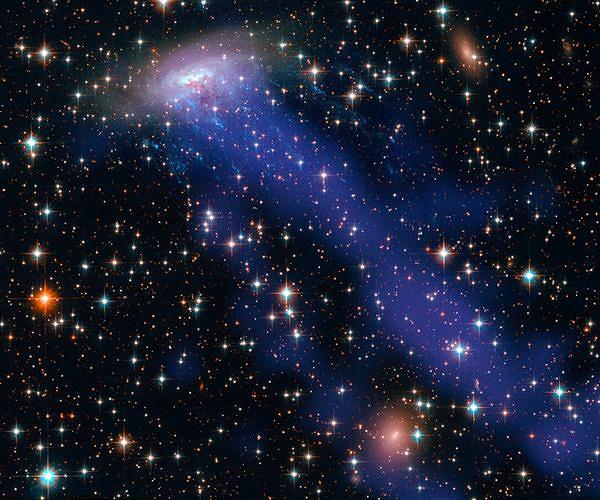
The newly forming stars in the tail are mysterious because processes common in large groups of galaxies should make it difficult for new stars to emerge. Most galaxies live in groups – for example, the Milky Way is a member of the Local Group, which also contains galaxies like Andromeda and the Triangulum spiral. Some galaxies reside in much larger gatherings of hundreds or even thousands of galaxies known as a galaxy cluster. The “jellyfish” galaxy ESO 137-001 is part of a cluster called Abell 3627.
A galaxy cluster isn’t just galaxies surrounded by empty space. The realm between the galaxies is filled with hot, tenuous gas. For galaxies living in the cluster or a wandering galaxy that gets pulled in by the cluster’s gravity, that gas acts like a headwind. That wind can remove gas and dust from the hapless galaxy in a process known as “ram pressure stripping.”
As a result, ram pressure stripping can slow star formation in the affected galaxy. Galaxies need gas to form stars. Eventually, all galaxies run out of gas and star formation stops. Ram pressure stripping can hasten that end.
This is one reason why galaxies in clusters stop forming new stars sooner than their relatives outside of clusters. But, the mechanisms involved are still mysterious.
“Both gas and dust are getting stripped off, but how much and what happens to the stripped material and the galaxy itself are still open questions,” said Stacey Alberts of the University of Arizona, a co-investigator on the project.
A STAR FORMATION MYSTERY
ESO 137-001 is a spiral galaxy similar in size to the Milky Way, and slightly less massive. Its tail extends across 260,000 light-years of space, almost three times the galaxy’s width. Galactic tails like this are difficult to spot because they are so tenuous. Surprisingly, stars seem to be forming in this tail.
Webb will target sites of star formation at different points along the tail: close to the galaxy, in the middle, and near the end of the tail. Since material at the tail’s end was removed before material close to the galaxy, astronomers can learn how the stripping process changed over time and how that affected conditions to form new stars.
Researchers aren’t sure how stars are able to form at all within the tail since the stripping process should have heated the gas. “We think it’s hard to strip off a molecular cloud that’s already forming stars because it should be tightly bound to the galaxy by gravity. Which means either we’re wrong, or this gas got stripped off and heated up, but then had to cool again so that it could condense and form stars,” explained Alberts.
 The Sci-Fi