
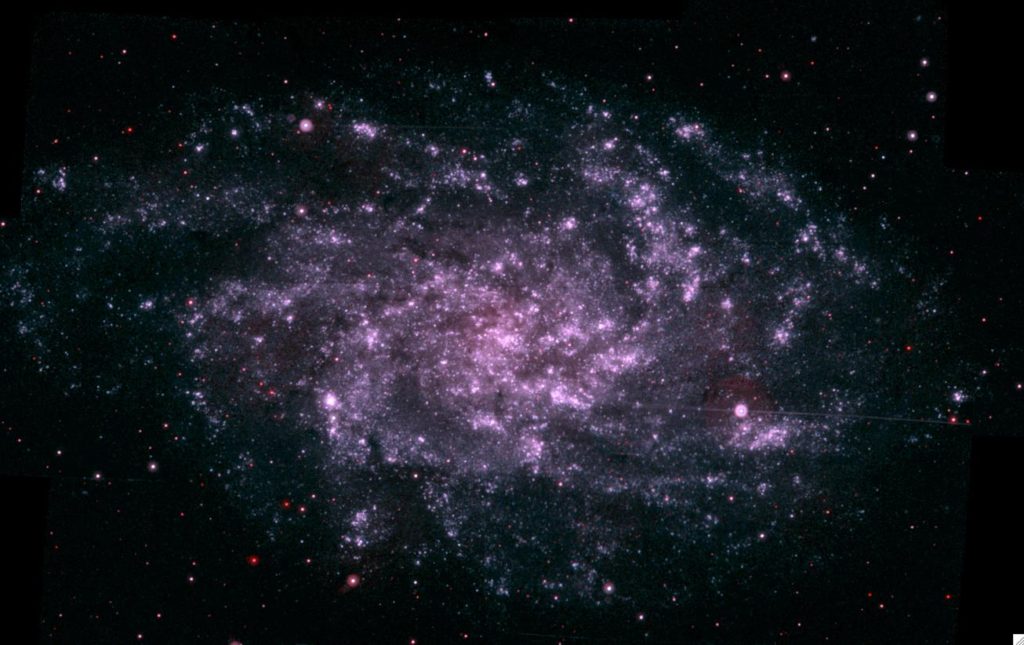
When the NASA’s Swift satellite first stared taking pictures in 2007-2008, it focused on the Triangulum Galaxy. At the time, it created the “most detailed ultraviolet image of an entire galaxy ever taken.” The bright purples and blues highlight the star formation happening in the Triangulum Galaxy.
• It is often mistakenly called the Pinwheel Galaxy, but the official “Pinwheel Galaxy” is actually Messier 101.
• It is likely that the Triangulum Galaxy interacted with the nearby, larger Andromeda Galaxy in the past.
• There are several streams of neutral hydrogen and stars linking the two galaxies, which is why scientists think they may have interacted in the past.
•The Andromeda Galaxy and Milky Way are both larger than the Triangulum Galaxy.
•The Triangulum Galaxy may be an example of an “inside-out” galaxy formation. In this process, gas is exhausted at the galaxy’s inner core and is accumulated toward the outer edges of the galaxy. This results in an inner core and outer halo with different compositions. Scientists have observed these two distinct areas in the Triangulum Galaxy.
• An Arizona photographer Chris Schur made headlines in 2016 when he released a stunning image of the Triangulum Galaxy. This is the photo he took.
 The Sci-Fi