
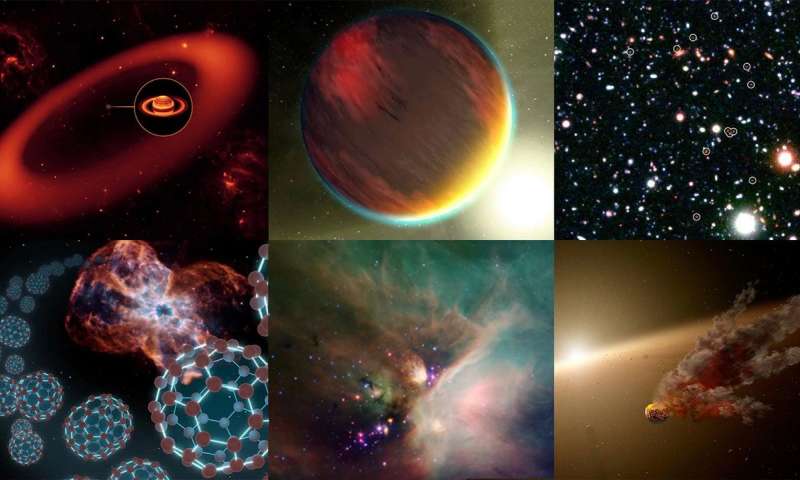
NASA’s Spitzer Space Telescope has spent 15 years in space. In honor of this anniversary, 15 of Spitzer’s greatest discoveries are featured in a gallery.
Launched into a solar orbit on Aug. 25, 2003, Spitzer trails behind Earth and has been gradually drifting farther away from our planet. Spitzer was the final of NASA’s four Great Observatories to reach space. Initially scheduled for a minimum 2.5-year primary mission, NASA’s Spitzer Space Telescope has lasted far beyond its expected lifetime.
#15: The first exoplanet weather map
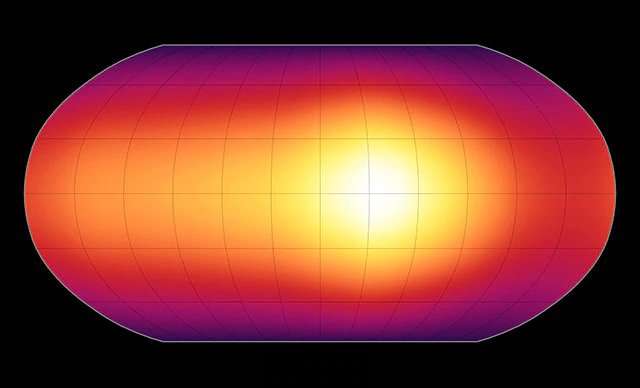
Spitzer detects infrared light, which is often emitted by warm objects such as heat radiation. While Spitzer mission designers never planned to use the observatory to study planets beyond our solar system, its infrared vision has proven to be an invaluable tool in this field.
In May 2009, scientists using data from Spitzer produced the first-ever “weather map” of an exoplanet—a planet that orbits a star other than the Sun. This exoplanet weather map charted temperature variations over the surface of a giant gas planet, HD 189733b. In addition, the study revealed that roaring winds likely whip through the planet’s atmosphere. The image above shows an artist’s impression of the planet.
#14: Hidden cradles of newborn stars
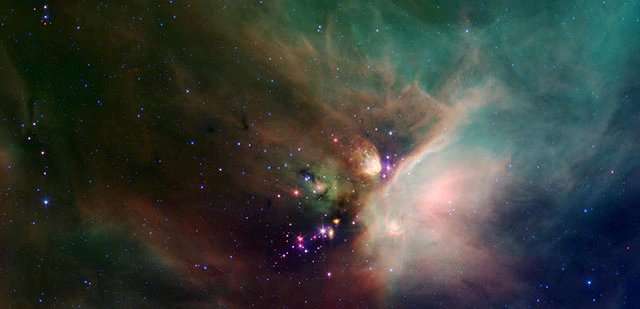
Infrared light can, in most cases, penetrate gas and dust clouds better than visible light. As a result, Spitzer has provided unprecedented views into regions where stars are born. This image from Spitzer shows newborn stars peeking out from beneath their natal blanket of dust in the Rho Ophiuchi dark cloud.
Called “Rho Oph” by astronomers, this cloud is one of the closest star-forming regions to our own Solar System. Located near the constellations Scorpius and Ophiuchus on the sky, the nebula is about 410 light years away from Earth.
#13: A growing galactic metropolis
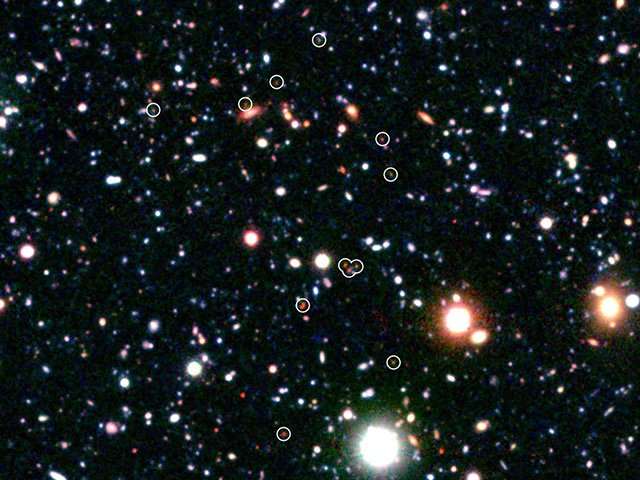
In 2011, astronomers using Spitzer detected a very distant collection of galaxies called COSMOS-AzTEC3. The light from this group of galaxies had traveled for more than 12 billion years to reach Earth.
Astronomers think objects like this one, called a proto-cluster, eventually grew into modern galaxy clusters, or groups of galaxies bound together by gravity. COSMOS-AzTEC3 was the most distant proto-cluster ever detected at the time.It provides researchers with a better idea of how galaxies have formed and evolved throughout the history of the universe.
#12: The recipe for ‘comet soup’
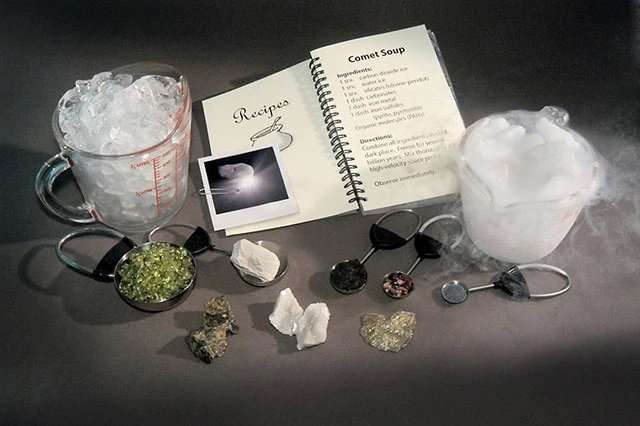
When NASA’s Deep Impact spacecraft intentionally smashed into comet Tempel 1 on July 4, 2005, it expelled a cloud of material that contained the ingredients of our solar system’s primordial “soup.” Combining data from Deep Impact with observations by Spitzer, astronomers analyzed that soup and began to identify the ingredients that eventually produced planets, comets and other bodies in our solar system.
Many of the components identified in the comet dust were known comet ingredients, such as silicates, or sand. But there were also surprise ingredients, such as clay, carbonates (found in seashells), iron-bearing compounds, and aromatic hydrocarbons that are found in barbecue pits and automobile exhaust on Earth. The study of these ingredients provides valuable clues about the formation of our solar system.
#11: The largest known ring around Saturn
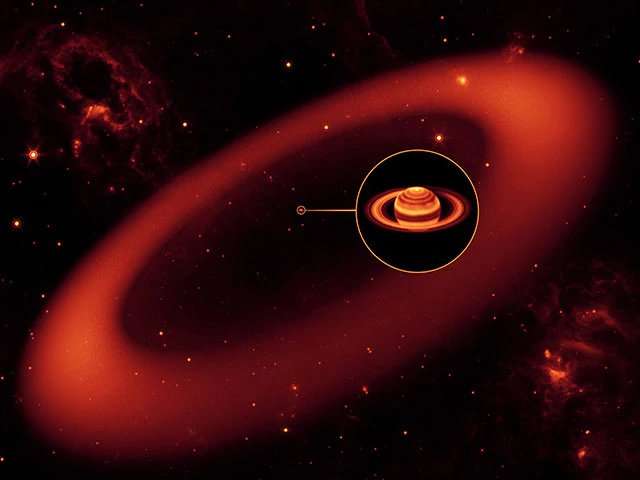
Saturn’s stunning ring system has been photographed extensively, but those portraits have not revealed the planet’s largest ring. The wispy structure is a diffuse collection of particles that orbits Saturn much farther from the planet than any of the other known rings. The ring starts about six million kilometers (3.7 million miles) away from the planet. It is about 170 times wider than the diameter of Saturn, and about 20 times thicker than the diameter of the planet. If we could see the ring with our eyes, it would be twice the size of the full Moon in the sky.
One of Saturn’s farthest moons, Phoebe, circles within the ring and is likely the source of its material. The relatively small numbers of particles in the ring don’t reflect much visible light, especially out at Saturn’s orbit where sunlight is weak, which is why it remained hidden for so long. Spitzer was able to detect the glow of cool dust in the ring, which has a temperature of about minus 316 degrees Fahrenheit or minus 193 degrees Celsius, which is 80 Kelvin.
#10: Buckyballs in space
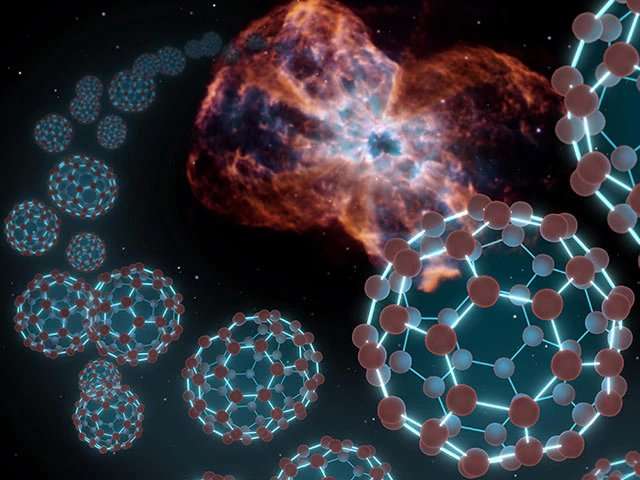
Buckyballs are spherical carbon molecules that have the hexagon-pentagon pattern seen on the surface of a soccer ball. However, buckyballs are named for their resemblance to geodesic domes designed by architect Buckminster Fuller. These spherical molecules belong to a class of molecules known as buckminsterfullerenes, or fullerenes, which have applications in medicine, engineering and energy storage.
Spitzer was the first telescope to identify Buckyballs in space. It discovered the spheres in the material around a dying star, or planetary nebula, called Tc 1. The star at the center of Tc 1 was once similar to our Sun, but as it aged, it sloughed off its outer layers, leaving only a dense white-dwarf star. Astronomers believe buckyballs were created in layers of carbon that were blown off the star. Follow-up studies using Spitzer data have helped scientists learn more about the prevalence of these unique carbon structures in nature.
 The Sci-Fi