
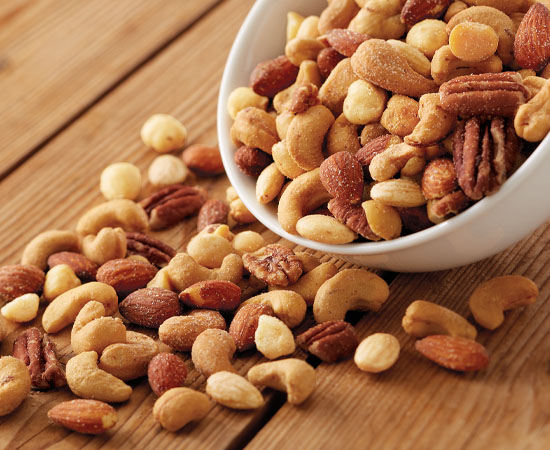
Perhaps you’ve noticed that, in bowls of mixed nuts, the Brazil nuts always seem to be sitting on top. This is known as the “Brazil nut effect,” and the seemingly mundane phenomenon is actually one of the biggest unsolved mysteries in many-body physics the science that describes large quantities of interacting objects.
Among an assortment of things (whether they be nuts, sedimentary deposits, or other objects of varying sizes), larger pieces rise to the top over time in spite of their greater gravitas, while smaller objects tend to sink lower in the pile over time. Perhaps the small stuff is trickling through cracks. Convection currents may also play a role, as might condensation of smaller particles. All of these possibilities and a few more probably contribute to the Brazil nut effect, but no one knows which ones, or to what extent, so no successful computer simulations of the phenomenon have been made.
Not only nut manufacturers, but also physicists, astronomers and geologists would all benefit from an understanding of the effect, so next time you’re eating nuts or granola, or fishing the crumbs out of the bottom of a bowl of Doritos, try contemplating the physics involved.
 The Sci-Fi