Facts about stars πŸŒ‰πŸŒ‰πŸŒ‰

Every star you see in the night sky is bigger and brighter than our sun. Of the 5,000 or so stars brighter than magnitude 6, only a handful of very faint stars are approximately the same size and brightness of our sun and the rest are all bigger and brighter. Of the 500 or so that are brighter than 4th magnitude (which includes essentially every star visible to the unaided eye from a urban location), all are intrinsically bigger and brighter than our sun, many by a large percentage. Of the brightest 50 stars visible to the human eye from Earth, the least intrinsically bright is Alpha Centauri, which is still more than 1.5 times more luminous than our sun, and cannot be easily seen from most of the Northern Hemisphere.

Every star you see in the night sky is bigger and brighter than our sun.Β Of the 5,000 or so stars brighter than magnitude 6, only a handful of very faint stars are approximately the same size and brightness of our sun and the rest are all bigger and brighter. Of the 500 or so that are brighter than 4th magnitude (which includes essentially every star visible to the unaided eye from a urban location), all are intrinsically bigger and brighter than our sun, many by a large percentage. Of the brightest 50 stars visible to the human eye from Earth, the least intrinsically bright is Alpha Centauri, which is still more than 1.5 times more luminous than our sun, and cannot be easily seen from most of the Northern Hemisphere.

You can’t see millions of stars on a dark night.Despite what you may hear in TV commercials, poems and songs, you cannot see a million stars … anywhere. There simply are not enough close enough and bright enough. On a really exceptional night, with no Moon and far from any source of lights, a person with very good eyesight may be able to see 2000-2500 stars at any one time. (Counting even this small number still would be difficult.). So the next time you hear someone claim to have seen a million stars in the sky, just appreciate it as artistic license or exuberant exaggeration – because it isn’t true!

3. Red hot and cool ice blue – NOT! We are accustomed to referring to things that are red as hot and those that are blue as cool. This is not entirely unreasonable, since a red, glowing fireplace poker is hot and ice, especially in glaciers and polar regions, can have a bluish cast. But we say that only because our everyday experience is limited. In fact, heated objects change color as their temperature changes, and red represents the lowest temperature at which a heated object can glow in visible light. As it gets hotter, the color changes to white and ultimately to blue. So the red stars you see in the sky are the β€œcoolest” (least hot), and the blue stars are the hottest!

4. Stars are black bodies. A black body is an object that absorbs 100 percent of all electromagnetic radiation (that is, light, radio waves and so on) that falls on it. A common image here is that of a brick oven with the interior painted black and the only opening a small window. All light that shines through the window is absorbed by the interior of the oven and none is reflected outside the oven. It is a perfect absorber. As it turns out, this definition of being perfect absorbers suits stars very well! However, this just says that a blackbody absorbs all the radiant energy that hits it, but does not forbid it from re-emitting the energy. In the case of a star, it absorbs all radiation that falls on it, but it also radiates back into space much more than it absorbs. Thus a star is a black body that glows with great brilliance! (An even more perfect black body is a black hole, but of course, it appears truly black, and radiates no light.)

5. There are no green stars. Although there are scattered claims for stars that appear green, including Beta Librae (Zuben Eschamali), most observers do not see green in any stars except as an optical effect from their telescopes, or else an idiosyncratic quirk of personal vision and contrast. Stars emit a spectrum (β€œrainbow”) of colors, including green, but the human eye-brain connection mixes the colors together in a manner that rarely if ever comes out green. One color can dominate the radiation, but within the range of wavelengths and intensities found in stars, greens get mixed with other colors, and the star appears white. For stars, the general colors are, from lower to higher temperatures, red, orange, yellow, white and blue. So as far as the human eye can tell, there are no green stars.

6. Our sun is a green star. That being said, the sun is a β€œgreen” star, or more specifically, a green-blue star, whose peak wavelength lies clearly in the transition area on the spectrum between blue and green.  This is not just an idle fact, but is important because the temperature of a star is related to the color of its most predominate wavelength of emission. (Whew!) In the sun’s case, the surface temperature is about 5,800 K, or 500 nanometers, a green-blue. However, as indicated above, when the human eye factors in the other colors around it, the sun’s apparent color comes out a white or even a yellowish white.

7. Our sun is a dwarf star. We are accustomed to think of the sun as a β€œnormal” star, and in many respects, it is. But did you know that it is a β€œdwarf” star? You may have heard of a β€œwhite dwarf,” but that is not a regular star at all, but the corpse of a dead star. Technically, as far as β€œnormal” stars go (that is, astronomical objects that produce their own energy through sustained and stable hydrogen fusion), there are only β€œdwarfs,” β€œgiants” and β€œsupergiants.” The giants and supergiants represent the terminal (old age) stages of stars, but the vast majority of stars, those in the long, mature stage of evolution (Main Sequence) are all called β€œdwarfs.” There is quite a bit of range in size here, but they are all much smaller than the giants and supergiants. So technically, the sun is a dwarf star, sometimes called β€œYellow Dwarf” in contradiction to the entry above!

8. Stars don’t twinkle. Stars appear to twinkle (β€œscintillate”), especially when they are near the horizon. One star, Sirius, twinkles, sparkles and flashes so much some times that people actually report it as a UFO. But in fact, the twinkling is not a property of the stars, but of Earth’s turbulent atmosphere. As the light from a star passes through the atmosphere, especially when the star appears near the horizon, it must pass through many layers of often rapidly differing density. This has the effect of deflecting the light slightly as it were a ball in a pinball machine. The light eventually gets to your eyes, but every deflection causes it to change slightly in color and intensity. The result is β€œtwinkling.” Above the Earth’s atmosphere, stars do not twinkle.

9. You can see 20 quadrillion miles, at least. On a good night, you can see about 19,000,000,000,000,000 miles, easily. That’s 19 quadrillion miles, the approximate distance to the bright star Deneb in Cygnus. which is prominent in the evening skies of Fall and Winter. Deneb is bright enough to be seen virtually anywhere in the Northern hemisphere, and in fact from almost anywhere in the inhabited world. There is another star, Eta Carina, that is a little more than twice as far away, or about 44 quadrillion miles. But Eta Carina is faint, and not well placed for observers in most of the Northern hemisphere. Those are stars, but both the Andromeda Galaxy and the Triangulum Galaxy are also visible under certain conditions, and are roughly 15 and 18 quintillion miles away! (One quintillion is 10^18!)

10. Black holes don’t suck. Many writers frequently describe black holes as β€œsucking” in everything around them. And it is a common worry among the ill-informed that the so-far hypothetical β€œmini” black holes that may be produced by the Large Hadron Collider would suck in everything around them in an ever increasing vortex that would consume the Earth! β€œSay it ain’t so, Joe!” Well, I am not Shoeless Joe Jackson, but it ain’t so. In the case of the LHC, it isn’t true for a number of reasons, but black holes in general do not β€œsuck.”

This not just a semantic distinction, but one of process and consequence as well. The word β€œsuck” via suction, as in the way vacuum cleaners work, is not how black holes attract matter. In a vacuum cleaner, the fan produces a partial vacuum (really, just a slightly lower pressure) at the floor end of the vacuum, and regular air pressure outside, being greater, pushes the air into it, carrying along loose dirt and dust.

In the case of black holes, there is no suction involved. Instead, matter is pulled into the black hole by a very strong gravitational attraction. In one way of visualizing it, it really is a bit like falling into a hole, but not like being hoovered into it. Gravity is a fundamental force of Nature, and all matter has it. When something is pulled into a black hole, the process is more like being pulled into like a fish being reeled in by an angler, rather than being pushed along like a rafter inexorably being dragged over a waterfall.

The difference may seem trivial, but from a physical standpoint it is fundamental.

So black holes don’t suck, but they are very cool. Actually, they are cold. Very, very cold. But that’s a story for another time.

MILKY WAY FACTS🌌🌌🌌🌌

Viewed from above, we can now see that our gaze takes across the Perseus Arm (toward the constellation Cygnus), parts of the Sagittarius and Scutum-Centaurus arms (toward the constellations Scutum, Sagittarius and Ophiuchus) and across the central bar. Interstellar dust obscures much of the center of the galaxy. Credit: NASA et. all with additions by the author.

Β Viewed from above, we can now see that our gaze takes across the Perseus Arm (toward the constellation Cygnus), parts of the Sagittarius and Scutum-Centaurus arms (toward the constellations Scutum, Sagittarius and Ophiuchus) and across the central bar. Interstellar dust obscures much of the center of the galaxy. Credit: NASA et. all with additions by the author.The Milky Way Galaxy is an immense and very interesting place. Not only does it measure some 120,000–180,000 light-years in diameter, it is home to planet Earth, the birthplace of humanity. Our Solar System resides roughly 27,000 light-years away from the Galactic Center, on the inner edge of one of the spiral-shaped concentrations of gas and dust particles called the Orion Arm. But within these facts about the Milky Way lie some additional tidbits of information, all of which are sure to impress and inspire. Here are ten such facts, listed in no particular order:

1. It’s Warped:

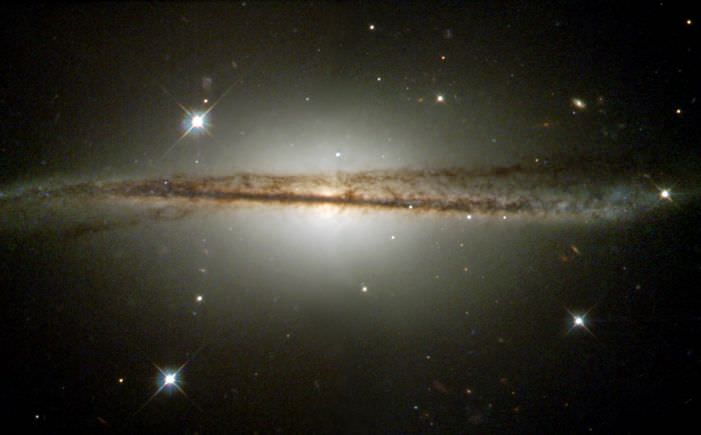
For starters, the Milky Way is a disk about 120,000 light years across with a central bulge that has a diameter of 12,000 light years (see the Guide to Space article for more information). The disk is far from perfectly flat though, as can be seen in the picture below. In fact, it is warped in shape, a fact which astronomers attribute to the our galaxy’s two neighbors -the Large and Small Magellanic clouds. These two dwarf galaxies β€” which are part of our β€œLocal Group” of galaxies and may be orbiting the Milky Way β€” are believed to have been pulling on the dark matter in our galaxy like in a game of galactic tug-of-war. The tugging creates a sort of oscillating frequency that pulls on the galaxy’s hydrogen gas, of which the Milky Way has lots of (for more information, check out How the Milky Way got its Warp).

The Spiral Galaxy ESO 510-13 is warped similar to our own. Credit: NASA/Hubble Heritage Team (STScI / AURA), C. Conselice (U. Wisconsin / STScI/ NASA
The warp of Spiral Galaxy ESO 510-13 is similar to that of our own. Credit: NASA/Hubble

2. It Has a Halo, but You Can’t Directly See It:

Scientists believe that 90% of our galaxy’s mass consists of dark matter, which gives it a mysterious halo. That means that all of the β€œluminous matter” – i.e. that which we can see with the naked eye or a telescopes – makes up less than 10% of the mass of the Milky Way. Its halo is not the conventional glowing sort we tend to think of when picturing angels or observing comets. In this case, the halo is actually invisible, but its existence has been demonstrated by running simulations of how the Milky Way would appear without this invisible mass, and how fast the stars inside our galaxy’s disk orbit the center. The heavier the galaxy, the faster they should be orbiting. If one were to assume that the galaxy is made up only of matter that we can see, then the rotation rate would be significantly less than what we observe. Hence, the rest of that mass must be made up of an elusive, invisible mass – aka. β€œdark matter” – or matter that only interacts gravitationally with β€œnormal matter”. To see some images of the probable distribution and density of dark matter in our galaxy, check out The Via Lactea Project.

3. It has Over 200 Billion Stars:

As galaxies go, the Milky Way is a middleweight. The largest galaxy we know of, which is designated IC 1101, has over 100 trillion stars, and other large galaxies can have as many as a trillion. Dwarf galaxies such as the aforementioned Large Magellanic Cloud have about 10 billion stars. The Milky Way has between 100-400 billionstars; but when you look up into the night sky, the most you can see from any one point on the globe is about 2,500. This number is not fixed, however, because the Milky Way is constantly losing stars through supernovae, and producing new ones all the time (about seven per year).

These images taken by the Spitzer Space Telescope show the dust and gas concentrations around a supernova. Credit: NASA/JPL-Caltech
These images taken by the Spitzer Space Telescope show dust and gas concentrations around a distant supernova. Credit: NASA/JPL-Caltech

4. It’s Really Dusty and Gassy:

Though it may not look like it to the casual observer, the Milky Way is full of dust and gas. This matter makes up a whopping 10-15% of the luminous/visible matter in our galaxy, with the remainder being the stars. Our galaxy is roughly 100,000 light years across, and we can only see about 6,000 light years into the disk in the visible spectrum. Still, when light pollution is not significant, the dusty ring of the Milky Way can be discerned in the night sky. The thickness of the dust deflects visible light (as is explained here) but infrared light can pass through the dust, which makes infrared telescopes like the Spitzer Space Telescope extremely valuable tools in mapping and studying the galaxy. Spitzer can peer through the dust to give us extraordinarily clear views of what is going on at the heart of the galaxy and in star-forming regions.

5. It was Made From Other Galaxies:

The Milky Way wasn’t always as it is today – a beautiful, warped spiral. It became its current size and shape by eating up other galaxies, and is still doing so today. In fact, the Canis Major Dwarf Galaxy is the closest galaxy to the Milky Way because its stars are currently being added to the Milky Way’s disk. And our galaxy has consumed others in its long history, such as the Sagittarius Dwarf Galaxy.

6. Every Picture You’ve Seen of the Milky Way Isn’t It:

Currently, we can’t take a picture of the Milky Way from above. This is due to the fact that we are inside the galactic disk, about 26,000 light years from the galactic center. It would be like trying to take a picture of your own house from the inside. This means that any of the beautiful pictures you’ve ever seen of a spiral galaxy that is supposedly the Milky Way is either a picture of another spiral galaxy, or the rendering of a talented artist.

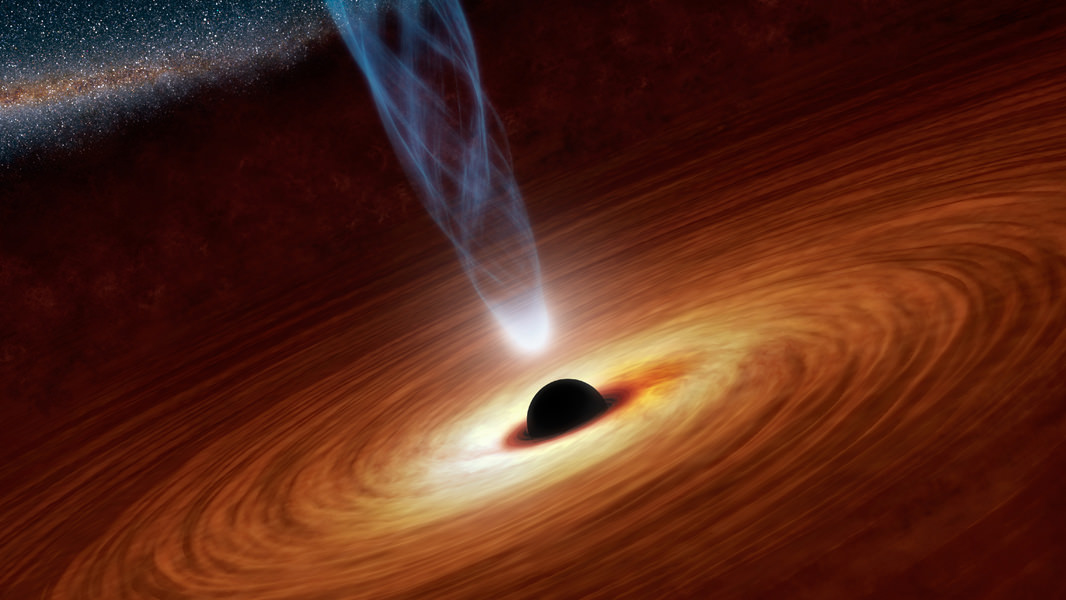
Artist's concept of Sagittarius A, the supermassive black hole at the center of our galaxy. Credit: NASA/JPL
Artist’s concept of Sagittarius A, the supermassive black hole at the center of our galaxy. Credit: NASA/JPL-Caltech

Imaging the Milky Way from above is a long, long way off. However, this doesn’t mean that we can’t take breathtaking images of the Milky Way from our vantage point!

7. There is a Black Hole at the Center:

Most larger galaxies have a supermassive black hole (SMBH) at the center, and the Milky Way is no exception. The center of our galaxy is called Sagittarius A*, a massive source of radio waves that is believed to be a black hole that measures 22,5 million kilometers (14 million miles) across – about the size of Mercury’s orbit. But this is just the black hole itself. All of the mass trying to get into the black hole – called the accretion disk – forms a disk that has 4.6 million times the mass of our Sun and would fit inside the orbit of the Earth. Though like other black holes, Sgr A* tries to consume anything that happens to be nearby, star formation has been detected near this behemoth astronomical phenomenon.

Loading video

8. It’s Almost as Old as the Universe Itself:

The most recent estimates place the age of the Universe at about 13.7 billion years. Our Milky Way has been around for about 13.6 billion of those years, give or take another 800 million. The oldest stars in our the Milky Way are found in globular clusters, and the age of our galaxy is determined by measuring the age of these stars, and then extrapolating the age of what preceded them. Though some of the constituents of the Milky Way have been around for a long time, the disk and bulge themselves didn’t form until about 10-12 billion years ago. And that bulge may have formed earlier than the rest of the galaxy.

9. It’s Part of the Virgo Supercluster:

As big as it is, the Milky Way is part of an even larger galactic structures. Our closest neighbors include the Large and Small Magellanic Clouds, and the Andromeda Galaxy – the closest spiral galaxy to the Milky Way. Along with some 50 other galaxies, the Milky Way and its immediate surroundings make up a cluster known as the Local Group.

A mosaic of telescopic images showing the galaxies of the Virgo Supercluster. Credit: NASA/Rogelio Bernal Andreo

And yet, this is still just a small fraction of our stellar neighborhood. Farther out, we find that the Milky Way is part of an even larger grouping of galaxiesknown as the Virgo Supercluster. Superclusters are groupings of galaxies on very large scales that measure in the hundreds of millions of light years in diameter. In between these superclusters are large stretches of open space where intrepid explorers or space probes would encounter very little in the way of galaxies or matter. In the case of the Virgo Supercluster, at least 100 galaxy groups and clusters are located within it massive 33 megaparsec (110 million light-year) diameter. And a 2014 study indicates that the Virgo Supercluster is only a lobe of a greater supercluster, Laniakea, which is centered on the Great Attractor.

10. It’s on the move:

The Milky Way, along with everything else in the Universe, is moving through space. The Earth moves around the Sun, the Sun around the Milky Way, and the Milky Way as part of the Local Group, which is moving relative to the Cosmic Microwave Background (CMB) radiation – the radiation left over from the Big Bang. The CMB is a convenient reference point to use when determining the velocity of things in the universe. Relative to the CMB, the Local Group is calculated to be moving at a speed of about 600 km/s, which works out to about 2.2 million km/h. Such speeds stagger the mind and squash any notions of moving fast within our humble, terrestrial frame of reference!

MOON FACTS

  • The Moon is the Earth’s only natural satellite. A natural satellite is a space body that orbits a planet, a planet like object or an asteroid.
  • It is the fifth largest moon in the Solar System. Learn more about the other moons in the Solar System.
  • The average distance from the Moon to the Earth is 384403 kilometres (238857 miles).
  • The Moon orbits the Earth every 27.3 days.
  • Mons Huygens is the tallest mountain on the Moon, it is 4700 metres tall, just over half the height of Mt Everest (8848m).
  • The Moon rotates on its axis in around the same length of time it takes to orbit the Earth. This means that from Earth we only ever see around 60% of its surface (50% at any one time).
  • The side that we can see from Earth is called the near side while the other side is called the far side (it is sometimes called the dark side despite the fact that it illuminated by the Sun just as much as the near side).
  • The effect of gravity is only about one fifth (17%) as strong on the surface of the Moon compared to the strength of gravity on the surface of the Earth.
  • The Soviet Union’s Luna program featured the first successful landing of an unmanned spacecraft on the surface of the Moon in 1966.
  • The USA’s NASA Apollo 11 mission in 1969 was the first manned Moon landing.
  • The first person to set foot on the Moon was Neil Armstrong.
  • The far side of the Moon looks quite different due to its lack of maria (ancient pools of solidified lava).
  • The surface of the Moon features a huge number of impact craters from cometsand asteroids that have collided with the surface over time. Because the Moon lacks an atmosphere or weather these craters remain well preserved.
  • Although research is continuing, most scientists agree that the Moon features small amounts of water.
  • The Moon is very hot during the day but very cold at night. The average surface temperature of the Moon is 107 degrees Celsius during the day and -153 degrees Celsius at night.
  • The Earth’s tides are largely caused by the gravitational pull of the Moon.
  • The phases of the Moon are: New Moon, Crescent, First Quarter, Waxing Gibbous, Full Moon, Waning Gibbous, Last Quarter, Crescent, New Moon….
  • A lunar eclipse occurs when the Earth is between the Sun and the Moon

REWILDING : HOW WOLVES RADICALLY CHANGE RIVERS…

How can wolvesΒ radically change rivers? Why do whales have the power to change the composition of the atmosphere? It seems everything’s more connected than we’ve ever realized.

Have you heard of rewilding? This inspiring TED Talk will quickly become one of your favorites as it makes you consider how this concept can make our lives better.

image: Wolves and ravens

Source: Barrett Hedges

TED is a global platform for ideas worth spreading, and on their site, you can get lost for hours in their content and never look back. In our house, we have two teenagers who have completely given up television for TED talks (on any subject under the sun) and a handful of podcasts that we will introduce you to here on EWC at some point in the future.

In any case, if you have 20 minutes to spare, this adventure is an extraordinary way to spend it!

George Monbiot takes us through a portal to an enchanted kingdom that could be our future and then finishes his TED Talk by bringing us an understanding of our particular role in a world of possibility.

Rewilding will bring you a story of hope.

Sustainable energy from algae

Have you ever avoided a floating glob of green algae while swimming in a lake?

What if that goo could be the new generation of renewable energy? Algae may be our destiny!

Image: Close-up photo of algae

Source: Pxhere

Did you know that algae is the most promising and sustainable source of biofuel? It can be grown on land or sea, and even purify waste water. It doubles its mass in a few hours and can be harvested daily, rather than seasonally like conventional crops used as biofuel sources. And best of all, for every gallon of fuel, we will also get 10 pounds (16 kg) of food to go with it!

Algae could potentially produce up to 60 times more oil per acre than land-based plants.

Yes, as our search for new innovations in sustainable biofuels landed on corn and soybeans, all the while algae was right there, hiding in plain sight, on slippery stone paths and in every single pond on earth. And that’s a good lesson for us. What if Mother nature has clever, even simple, solutions to almost all our problems?

Let’s start with something that is usually pretty boring: a graph. But look carefully at the far right column. This is an amazing window into possibility:

Image: Graph showing the production of biofuel from algae is 10 time more than nearest other source

Source: NASA Omega Project

What if we can harness this potential?

Let’s dive right into this! Here’s a great little introduction to the wonder on the horizon with DNews host, Trace Dominguez on the interesting youtube channel called Seeker.Via: Seeker1

Amazing!

I love that good question Trace asks early on in the video: β€œIf nature loves algae so much, why don’t humans?’

Perhaps that points to an almost fatal flaw in the way humans think: we let the β€œyuck factor” cloud our judgment all too often when we are problem-solving.

Let’s look closer now and dig into how this would actually work. Here’s more:Via: Stories2 Ok, now that we understand the what and the how, let’s let the world’s more entertaining algae expert give us some fascinating details from the TED stage. Jonathan Trent is credited on the NASA website for shepherding the Omega Project, NASA’s effort to explore membrane technology for algal enclosures in the ocean.

We’re hoping you know about TED.com and the amazing way TED Talks can change your worldview. Their tagline is β€œIdeas worth spreading” and that is certainly true. If you’d like to check out our favorite TED Talks of all time, check out our EWC Must-See TED Talk page.

Jonathan Trent is one of those rare scientists who can speak in a way that expands us all. His focus points at a beautiful way to think about the new generation of possibilities all around us. Enjoy this short talk:Via: TED3

So there’s a remarkable insight there. Did you catch it? He set out to find a pathway to innovative production of sustainable biofuels and wound up discovering more opportunities than he’d ever imagined.

What’s really required for sustainability is integration more than innovation… I think there is almost no limit to what we can accomplish if we are radically open and we don’t care who gets the credit. – Jonathan Trent

Maybe that’s where the future awaits us: in a place where we see roadblocks as opportunities

🌱🌱Plant in space🌱🌱

Just think about that for a moment, okay? All of life as we know it,Β literally everything in our records so far, has started on Earth… but not these plants. These are space plants.

These babies have grown up without gravity, swirling around our planet with a few galactic gardeners tending to them. So, what does this mean for us?

Image: An orange blooming zinnia plant that was grown in space floating inside of the ISS with the Earth behind it.

One of the surviving Zinnias grown in space! 
Source: Wikipedia // NASA

In order for us to go further into space and possibly colonize a new planet, these plants are needed. Thankfully, they seem to be doing just fine orienting themselves and growing without gravity!

But it’s not just the possibility of eating fresh produce alone that’s exciting, NASA says that β€œthe experiment also is investigating another benefit of growing plants in space: the non-nutritional value of providing comfort and relaxation to the crew.” 1

One of our favorite channels, Seeker, tells us all about what ingenious scientists, astronauts, and their plants have been up to recently, and what the next steps are…Via: Seeker2

I’m still finding it so fascinating that plants, even without the gravity they know, tend to grow as they would on Earth. According to an article from National Geographic News in 2012, where they discuss the NASA experiment with plant geneticist, Anna-Lisa Paul, the β€œnew study revealed that the β€œfeatures of plant growth we thought were a result of gravity acting on plant cells and organs do not actually require gravity.”  3

Here’s a quote from that piece on why:

β€œGravity is an important influence on root growth, but the scientists found that their space plants didn’t need it to flourish. The research team from the University of Florida in Gainesville thinks this ability is related to a plant’s inherent ability to orient itself as it grows. Seeds germinated on the International Space Station sprouted roots that behaved like they would on Earthβ€”growing away from the seed to seek nutrients and water in exactly the same pattern observed with gravity.” 4

We just need to figure out a way to ensure proper combinations of resources to keep our green friends healthy and resilient, so thatΒ weΒ can stay healthy and resilientΒ while we’re millions of miles away from home.

Does the possibility of gardening make living in space seem a little less intimidating? One of my biggest reservations about possibly living outside of this planet in the future is… what the heck are we going to do out there? We can’t even breathe the air! So how would we all utilize our time?

Are you looking forward to living outside of this planet? Share this article with your friends to let them know we’re steps closer to making it happen!

Can U Spot The Mistake?????

If x^x^x^x^x^…..upto infinity =2 and also let’s take y^y^y^y^y^…..upto infinity=4. But when u find the value of x and y it’s the same i.e.√2. Therefore, we can easily conclude that 2=4. But it is not possible in reality. So where is the mistake here?????

Amazing brain facts

  1. The human brain weighs 3 pounds
  2. It comprises 60% of fat and is one of the fattest organs in the human body
  3. Human brain has the capacity to generate approximately 23 watts of power when awake.
  4. Of the total blood and oxygen that is produced in our body, the brain gets 20% of it.
  5. When the blood supply to the brain stops, it is almost after 8-10 seconds that the brain starts losing the consciousness.
  6. The brain is capable of surviving for 5 to 6 minutes only if it doesn’t get oxygen after which it dies.
  7. The blood vessels that are present in the brain are almost 100,000 miles in length.
  8. There are 100 billion neurons present in the brain.
  9. In early pregnancy, the neurons develop at an alarming rate of 250,000 per minute.
  10. Β As we grow older, we are unable to remember new things. According to the researchers in the US it is because the brain is unable to filter and remove old memories which prevent it from absorbing new ideas.

What if ozone layer disappear?

1.If that happens then harmful UV rays can reach on the surface of the earth.

2.Those UV rays can damage our eyes.

3. It Can cause diseases like skin cancer.

4. It can destroy our immune system.

5.Without ozone layer humans won’t last for 3 months.

6. Plants will die within weeks.

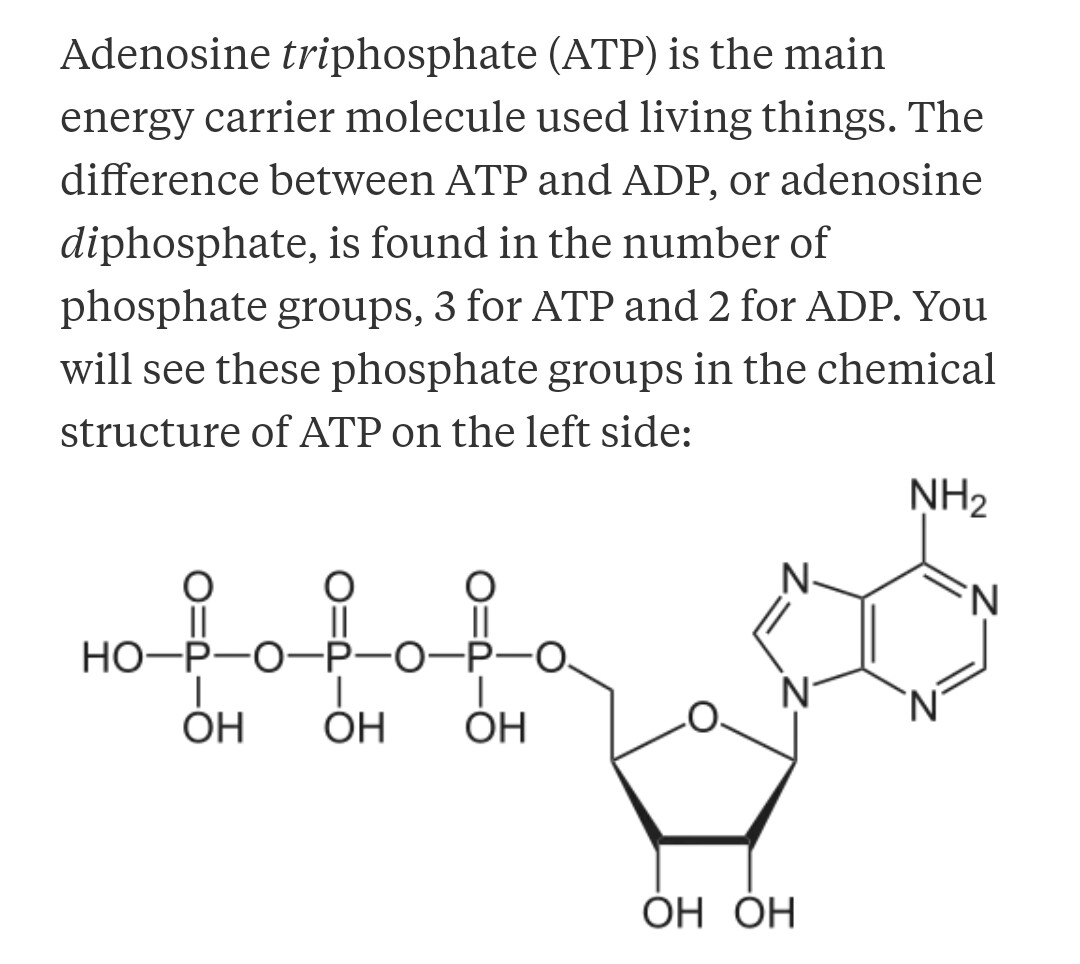
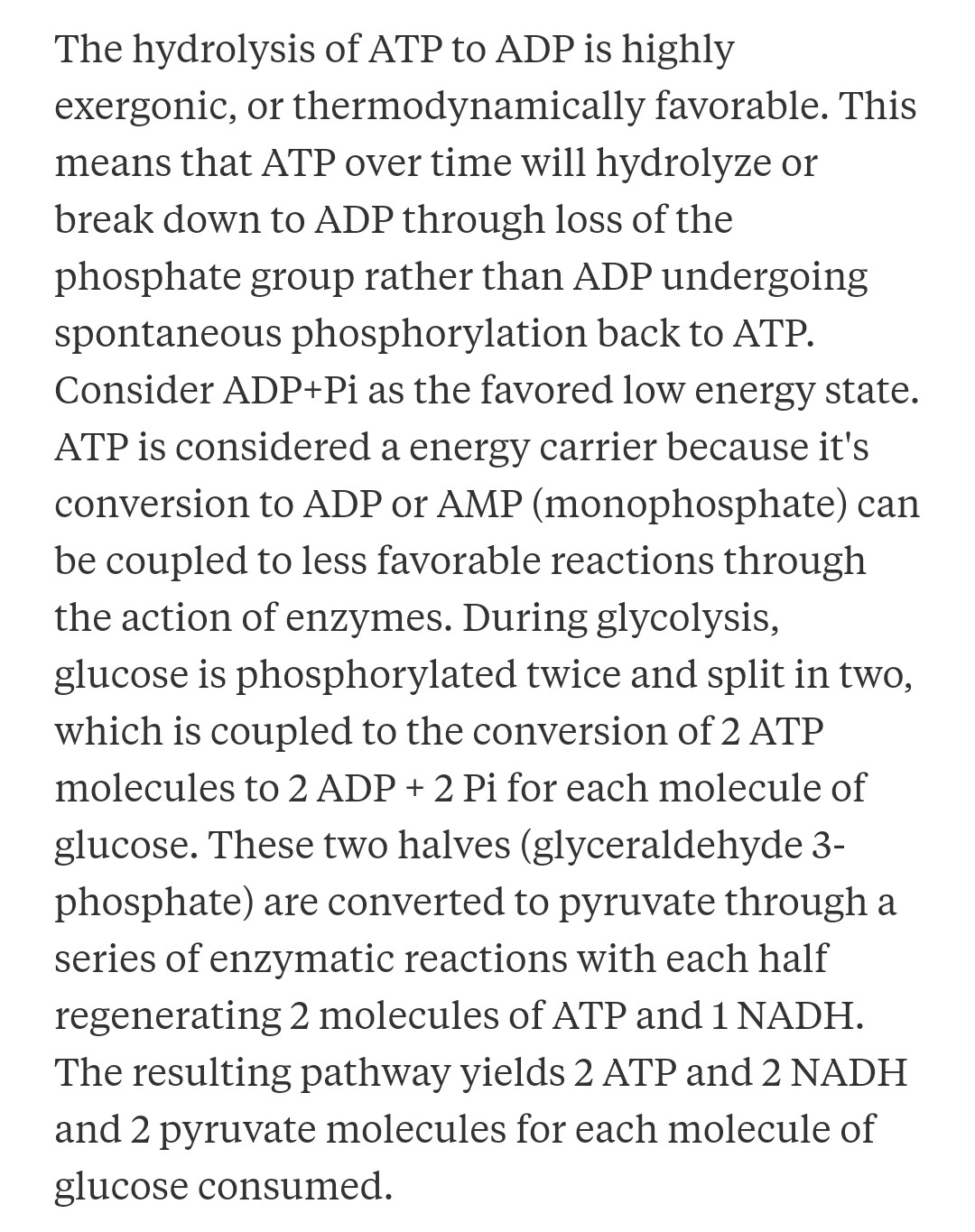
Difference between ADP and ATP

Why is sky blue?

Sunlight reaches earth’s atmosphere and is scattered in all directions by all the gases and particles in the air. Blue colour is scattered more than the other colours because it travels as shorter , smaller waves . This is why we see a blue sky most of the time.

The Amazing News For The Whole World

Design a site like this with WordPress.com
Get started